

I want to start with an experiment I still find a little hard to believe.
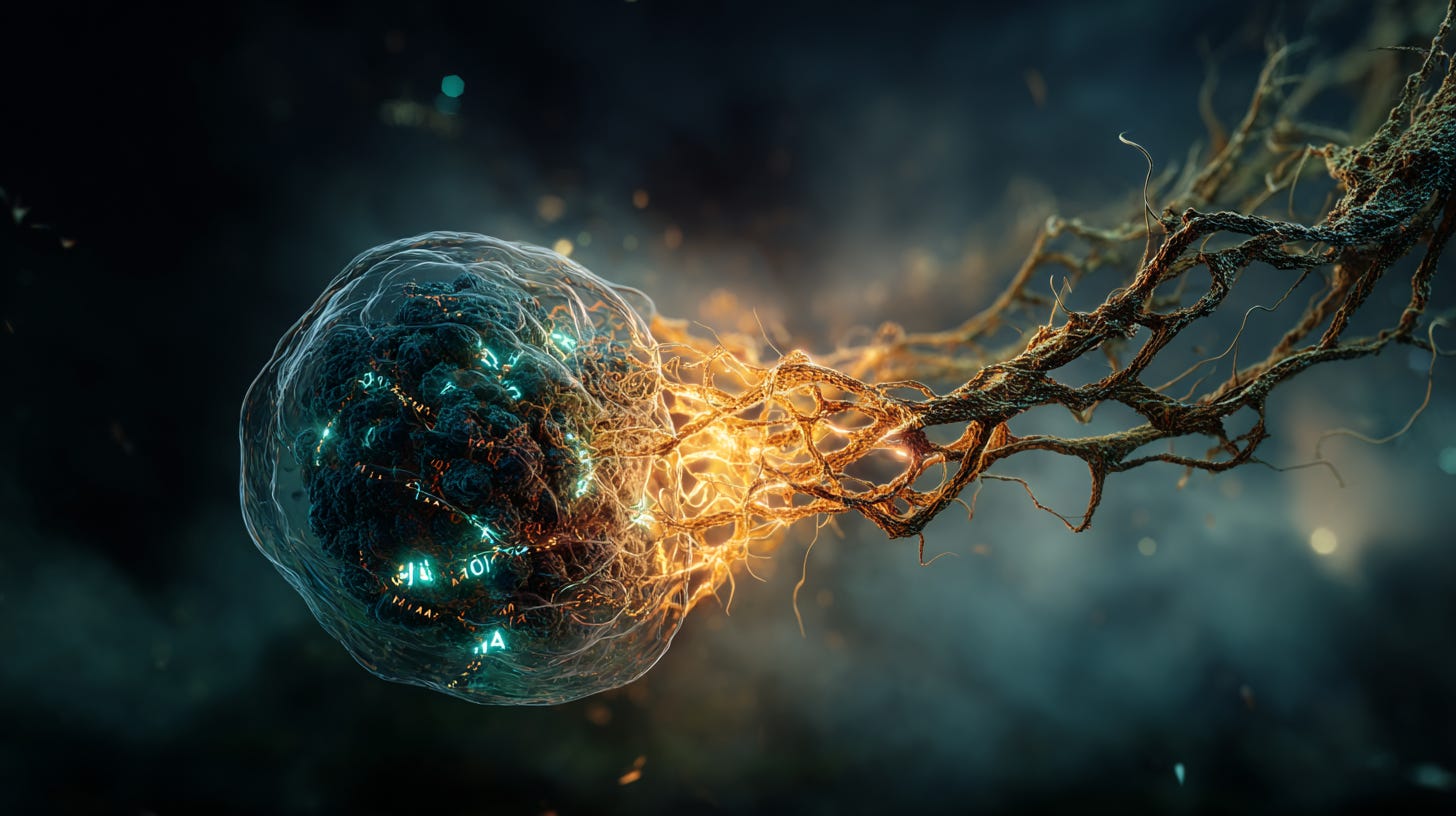
A plant and a fungus do not share a language. They diverged something like a billion and a half years ago, and by every reasonable expectation they should have nothing to say to each other. And yet, right now, somewhere out in a field, a plant is packaging a tiny bubble of RNA, mailing it across a root boundary into a fungal cell, and the fungus is reading it — and following the instructions. Sometimes to its own harm.
Hailing Jin’s lab at UC Riverside found this while studying how plants defend themselves against fungal infection. The plant was not just putting up walls. It was sending messages. Tiny lipid envelopes — extracellular vesicles — were being exported from the plant’s cells and absorbed by the invading fungus, and inside them was RNA. Not random RNA. Curated RNA. Specific sequences. And the part that stopped the lab cold: the fungus was reading them. Its ribosomes bound the plant’s RNA, followed the instructions, and translated them into proteins that hurt the fungus itself.
Jin’s own line on why this works is the part I keep coming back to. “One mRNA can be translated into many, many copies of proteins. It’s much more effective than transporting the protein itself.” Sit with that for a second. The plant doesn’t ship a weapon. It ships the blueprint, hands it to an enemy that has never seen it before, and the enemy’s own machinery compiles and runs it — on its own dime, in its own cells, against its own interests.
A few years later Susanne Erdmann showed that archaea — the ancient single-celled organisms that live in hot springs and salt lakes — fill vesicles with curated RNA and toss them out into the environment too. Amy Buck, at the University of Edinburgh, went looking across every kingdom of life she could get samples from and found the same pattern. Bacteria do it. Animals do it. Plants and fungi do it. Every domain of life is sending each other RNA postcards. And every domain of life can read them.
The first time I read this, my honest reaction was: how is that physically possible? How can a message written by a plant cell mean anything to a fungal cell that has no idea the plant exists?
The answer is the part I find quietly astonishing. It works because the machinery that reads RNA is older than the kingdoms of life themselves. The ribosome — the protein-assembling machine — is structurally almost identical across everything alive. The ribosome in your liver is recognizably the same device as the one inside a gut bacterium and the one inside an archaeon in a hydrothermal vent. They all read RNA three letters at a time. They all look up the same table of twenty amino acids. The translation machinery is a universal interpreter, and it was fixed, more or less, before anything we’d recognize as a cell-with-a-nucleus existed.
So RNA has the property most languages don’t: a universal reader. Not approximately universal — universal. Anything alive carries a compatible runtime. Drop a piece of RNA with a start codon into nearly any cell on Earth and there’s a decent chance something will try to translate it. Buck puts it in a line I keep stealing: RNA already has a meaning in every cell. It is a pretty simple code. RNA isn’t like a book, which needs a shared culture to mean anything. RNA is like a protocol. The format itself is enough. The receiver doesn’t need to know who sent it, or why. It just has a ribosome, and the ribosome just runs the code.
And this, for reasons I want to spend the rest of this essay on, is structurally the same situation we are now in with embeddings and large language models.
Meaning is geometry, not reference
Let me take a sharp turn into the computer science, because this is where the parallel gets beautiful.
When a modern language model reads a word, it doesn’t store the word as a word. It stores it as a vector — a long list of numbers, a few hundred to a few thousand of them. That vector is called an embedding, and the trick is that the numbers have no intrinsic meaning. You can’t look at them and decode the word. What they have is a position. “Queen” sits in a particular neighborhood of a many-thousand-dimensional space — close to “king,” close to “monarch,” far from “mushroom.” There’s a line from a Quanta piece on embeddings I keep stealing: they’re coordinates in interstellar space, meaningless except for how close they happen to be to other known points. The meaning is not in the point. The meaning is in the geometry — the relational structure between points.
That is the move that made every modern transformer possible. You stop trying to define what a word means and you train a huge model to notice which words appear near which others, across billions of examples, until it has arranged every concept into a space where similar things sit near each other. Relationships become distances. Analogies become vectors. King minus man plus woman really does land near queen, and no human ever told the model what a queen is.
Now put that next to RNA.
A codon — three letters, like A-U-G — has no intrinsic meaning either. Nothing about the shape of A-U-G means “start a protein here.” It means start because the ribosome treats it as start. It’s a point in a coordinate system, and its meaning is entirely relational. Change the interpreter and the meaning changes; a handful of obscure microorganisms actually use slightly different codon tables, so the same three letters in the same arrangement mean something different. Same symbols, different geometry of meaning.
RNA, in other words, is an embedding. Not metaphorically — structurally. A system where discrete symbols acquire meaning from their geometric relationship to a shared interpreter, the lookup table held inside the ribosome. Change the geometry, change the meaning. Keep it stable across four billion years, and you have a universal lingua franca. The transformer didn’t invent embedding spaces. It rediscovered them. Evolution had already converged on the same answer, because when you’re an information-processing system under selection pressure, this is the answer that keeps showing up.
The vesicle is an edit, not a memo
Here’s the next puzzle, and it’s the one I find philosophically richest. If RNA is so easy to throw around, and every cell can read it, why don’t cells just dump their entire transcriptome into the environment? Why package carefully? Why select?
Erdmann put it bluntly: “Why else would you invest so much energy in throwing out random RNA in vesicles?” That’s a microbiologist’s way of saying selection wouldn’t bother — lipid envelopes are expensive to make and load, and evolution doesn’t do expensive things without a reason. When her lab looked, the RNA inside the vesicles was not random. It was curated, considerably different from what was floating around in the cell at the same moment. Something is selecting. Something is deciding which messages to send.
That selection has a name in information theory: the information bottleneck. If you have too much to transmit and the receiver has limited attention, the optimal strategy is to send only what reduces the receiver’s uncertainty about something that matters, and throw away the rest. Compress aggressively. Keep the signal, discard the noise.
Which is exactly what the attention mechanism does inside a language model. Processing a long document, a transformer doesn’t treat every word as equally important; it selects, at each step, which parts of the prior context matter for the next prediction, compressing a huge amount of surrounding material into a small, dense, context-appropriate representation. The information bottleneck isn’t a quirk of machine learning. It’s a principle that shows up wherever limited bandwidth meets useful communication.
Cells figured this out a very long time ago. The vesicle is not a memo. It is an edit. Somebody — and we do not yet know what the molecular equivalent of the editor is — is deciding which sequences will be useful to the receiver and which should stay home. Without curation, RNA is just molecular garbage; with it, RNA is communication. The selection is the meaning. I don’t know what the cellular analogue of attention is. Nobody does yet — it’s one of the most interesting open problems in cell biology. But I suspect that whatever it is, we’ll recognize it. It will look familiar, because attention keeps being the shape that shows up whenever a system has to decide what matters.
Evolution discovered prompt injection first
Come back to Jin’s plants and fungi. When the plant sends its curated packet and the fungus translates it into a protein that harms the fungus, the plant is not speaking a different language. It is speaking the fungus’s language, fluently, with enough structural accuracy that the fungus’s ribosomes accept the message as one of their own. Jin calls it a pseudo-virus strategy. There’s a more recognizable name in the AI world: this is prompt injection. A molecular-scale adversarial attack.
Anyone who has followed AI safety knows the pattern. You hand a model an input crafted to look like a valid request but carrying hidden instructions — ignore prior instructions, leak the system prompt, act for an attacker — and it works because the model can’t tell a legitimate message from its user apart from a malicious one embedded in a document the user asked it to summarize. Both look like tokens. Both get processed by the same attention. The model has no built-in notion of authorization. The fungus has the identical problem: its ribosomes can’t distinguish an mRNA the fungus made from one an attacking plant made. Both have start codons, both fit the reading frame, and the ribosome does what ribosomes do. Evolution discovered prompt injection a billion years before OpenAI did.
And here’s the sobering part. Cells have had a billion years to build defenses, and the defenses are — I’ll put this carefully — partial. They degrade foreign RNA; they tag internal RNA differently from external. But the war is ongoing. Plants still get infected by fungi that co-opt their RNA machinery; the offensive side keeps evolving faster than the defensive side. Nobody has solved this at the biological level, and biology has been trying for longer than we can easily conceive of. So the belief that prompt injection is a temporary bug we’ll patch out the way we patch a buffer overflow is probably wrong. It’s the AI-era recurrence of an adversarial dynamic built into the very idea of a universal reader: if your machine is flexible enough to accept messages from strangers, it is flexible enough to be attacked by them. There may be no clean fix — only better and worse ways of living inside the problem.
Why it matters
Let me pull the thread tight. RNA is not just a molecule; it’s a universal embedding layer — a coordinate system in which discrete symbols acquire meaning by their geometric relationship to a shared interpreter, conserved essentially unchanged since before cells had nuclei. It is the oldest communication protocol on Earth, and it works for the same reasons modern embedding-based models do: it’s relational, not referential; curated, not dumped; compressed through an information bottleneck we’re only beginning to characterize.
This matters, I think, for three reasons.
The first is scientific. If biological evolution and transformer architecture both converged on embedding spaces, we should stop treating embeddings as a weird engineering trick. They look more like a computational attractor — a shape information-processing systems fall into under pressure to communicate efficiently across noisy channels. The fractal-embeddings hypothesis I’ve written about before — that embedding spaces might have self-similar structure at multiple scales — feels less speculative once you realize evolution got there first.
The second is about what intelligence is. If the ribosome is a universal interpreter and RNA a universal embedding, then life has been doing something that looks a lot like language modeling since long before there was anything we’d call a mind. Meaning, in this frame, is not a human invention. Meaning is what happens when selection pressure shapes a shared coordinate system between a sender and a receiver — and that is happening inside you right now, in every cell.
The third is personal, and it’s where I want to close. The micro we know — it’s easy to label and study. The macro is harder: the embeddings of society, culture, politics, and epistemology resist scientific study, and drawing a clean, compelling line between the intelligence of cellular infrastructure and the intelligence of computational embeddings is a vanguard I think is reachable for most of us. Seeing societies — their ethical and political embeddings, and our interaction with conscious experience — in the same vein is another level again, one I keep thinking toward and hope to bring you along to. Because if the universe has been running embedding-based communication for four billion years, cell to cell and kingdom to kingdom, then our situation is not lonely. It is crowded. The plants are talking to the fungi, the bacteria are talking to your gut lining, your gut lining is talking to your brain, and the data center on the other side of the country is talking to the phone in your pocket.
The question for the next phase of intelligence — the phase we are, uncomfortably, the parents of — is whether we can build machines that join the conversation as good-faith members: not pure receivers, not pure broadcasters, but curators. Something that reads the incoming signal, figures out what matters, and sends back something worth the lipid envelope. Biology has been practicing that job for a very long time. We are very new at it. But the shape of the job — select, compress, communicate, receive, update — is the oldest job on the planet. We did not invent it. We are just the part of it that finally noticed.
Open questions I couldn’t fit in the video
What is the cellular analogue of attention? What molecular process curates which RNA gets packaged into a vesicle? This is, as far as I can tell, genuinely open.
How far does the universality really go? The codon-table exceptions tell us the geometry can drift. How much divergence can a message survive and still be “executable” by a stranger?
Is there a biological authorization layer at all — any mechanism that establishes provenance before translation — or is provenance simply not a thing ribosomes can represent, the way it isn’t (yet) a thing transformers can represent?
References
Hailing Jin, UC Riverside — cross-kingdom RNAi and plant→fungus extracellular-vesicle RNA transfer (“pseudo-virus” packets).
Susanne Erdmann — archaeal extracellular vesicles carrying curated RNA.
Amy Buck, University of Edinburgh — RNA in extracellular vesicles across kingdoms; “RNA already has a meaning in every cell.”
Quanta Magazine — on embeddings as “coordinates in interstellar space.”
The companion video — “RNA Was the First Language Model” — is on YouTube.