

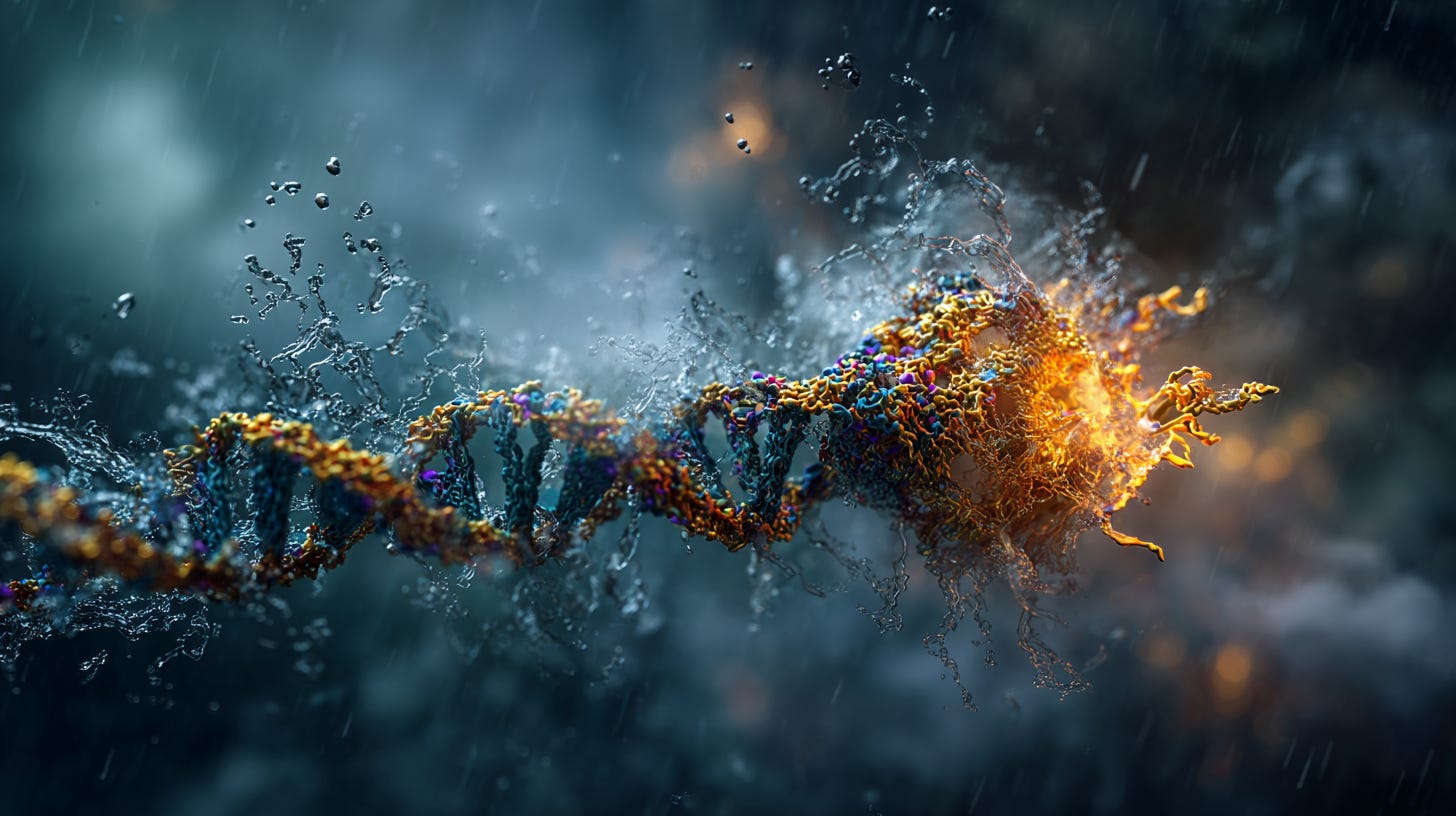
Maybe the question isn’t how to silence the noise. Maybe it’s what shape of machine turns noise into thought.
Inside every cell in your body, right now, something on the order of three hundred quintillion tiny machines are reading a four-letter language and building you out of it, one piece at a time. The number is real — a one with eighteen zeros after it — and the machines are not a metaphor for computers. They are computers. Wet ones. Noisy ones. Running on heat and randomness instead of clean electricity. I want to take that literally for a few minutes, because last year a research lab taught a language model to read and write the code these machines run, without ever showing it a biology textbook — and once you sit with what that means, the line between life and computation stops being a line and starts being a question about degree.
Start with the machine itself. The one to picture is called a ribosome, and the thing to understand about it is how badly it is treated by physics. My laptop works very hard to be quiet. Its bits do not wobble, its voltages stay clean, and we pour shielding and cooling and error-correction onto our chips for the single purpose of keeping noise out, because the kind of computing we know how to build cannot tolerate it. Flip one transistor with a stray cosmic ray and the operating system crashes. A ribosome is the opposite of that discipline. Every microsecond it is being slammed from every angle by water molecules, thousands of collisions a second, and each of its reading events is, in the strict sense, a coin flip that sometimes lands wrong. It has a measurable error rate baked into the physics of running a machine at body temperature — roughly one mistake in every ten thousand operations.
Feel how strange that is. If my laptop ran at a hundredth of a percent error rate it would be useless; I could not open the file I am writing this in. Your cells are running at that rate this very second, and they are not merely surviving it. They are using it. The randomness is not a defect the ribosome overcomes — it is the power source. The machine’s clever shape uses the random kicks to ratchet itself forward in one direction rather than the other, a waterwheel turned by static instead of falling water. Multiply by three hundred quintillion, each making slightly different mistakes, and the cell does not get one perfect answer. It gets a cloud of slightly wrong ones, averaged into something more adaptive and more creative than any single flawless machine could be.
I think about this every time someone calls an AI’s hallucinations a bug to be exterminated. The framing assumes a smart system should be a quiet system, that intelligence means driving variance to zero until only the one right answer remains. But biology is the most capable computational system we have ever met, and it runs on an error rate that would get a software engineer fired. So perhaps the question is not how to silence the noise. Perhaps it is what shape of machine turns noise into thought.
The Experiment That Made Everything Shift
Then there is the experiment that made me sit up straighter. A group led by Brian Hie took a transformer — the same architecture under every chatbot you have ever talked to — and fed it around three hundred billion base pairs of DNA. No annotations, no textbook glosses. Just the raw letters: A, C, G, T, scraped from the genomes of everything they could find. Then they asked it the only thing a language model knows how to do. Here is a stretch of symbols; what symbol comes next. That is precisely the task a chatbot performs on English. Hie’s model, called Evo, performed it on the language of life.
What came out should give everyone pause. Evo could read DNA — really read it, well enough to look at a sequence it had never seen and tell you which stretches would fold into working proteins. It could finish a half-written gene in a way that, when the DNA was actually synthesized and dropped into a living cell, produced functional protein. It could write entirely new sequences, ones evolution itself never wrote, that held up against four billion years of trial and error. And nobody ever told Evo what biology is. It has never seen a cell. It does not know that life exists. It learned the grammar of genes the way it would have learned the grammar of English — by noticing which symbols tend to follow which others across an enormous pile of examples, and quietly building a map of the structure underneath.
For decades people argued about whether “DNA is a language” was a real claim or a poetic gloss. Evo settles it toward real. If an architecture built for human language can pick up DNA the same way, and generate new working sentences in it the same way, then human language and genetic code are not similar in some evocative, hand-waving sense. They share a structural fact: both are sequences of discrete symbols where meaning rides on long stretches of context. The language of genes is not a metaphor for a language. It is one. And that leaves us somewhere uncomfortable, because a system with no body and no experience of being alive picked up the grammar of life from the text alone — which means we should be careful about what we mean when we say a model “understands” anything. Either Evo understands biology in some real sense, or it is faking it without understanding, and I am no longer confident those two descriptions differ in the way we want them to. That discomfort is not a hole in the philosophy. It is the philosophical moment we are standing in.
The Ground Shifts
Put the two pieces together and the ground shifts. DNA is literally code, and a language model can learn its grammar well enough to write new working programs in it. The machinery that reads the code is literally a computer, running at an error rate that turns out to be its superpower. Take both seriously — and the evidence for both is getting harder to wave off — and you arrive where the philosopher in me has been walking for twenty years. Life is not a thing. Life is a process, and a very particular kind of computation: it reads what surrounds it, writes back through its molecular machinery, and updates itself across generations under selection pressure. Read, write, update. That is the algorithm — the same proto-algorithm of selection that, somewhere in the early roughness of the universe, first composed randomness into the few patterns that managed to persist.
Saying it that way changes the shape of the old question. “Could a machine be alive?” stops being a category error and becomes a precision question: what kind of computation is the living kind, and what does it have that the server farm humming next to me does not? My best current answer, held loosely, is that living computation has at least three properties the AI we have built so far lacks. It is embodied — it runs on a physical body actively holding itself together against entropy, where my laptop maintains nothing and my cells maintain everything. It is noisy on purpose, using randomness as fuel rather than filtering it out as a flaw. And it has a history: every cell carries four billion years of training in its chemistry, in its membranes, in the strange compromises evolution made on the way to producing you. You can copy the software — sequence the DNA, write it to a drive. But the lineage that learned what to write is not in the software. It is in the four billion years it took to get written.
None of those three strike me as out of reach forever. They read more like a specification — the list of what an artificial system would actually have to satisfy before we could say, with a straight face, that it is not merely computing but living. Someone is going to write the first line of that specification, maybe this decade, maybe the next. What I am more confident of is the smaller claim underneath it. If life is running code, then we are not standing apart from the substrate, watching it from some clean exterior. We are the substrate, watching itself. Every time we teach a model to read DNA we are not making the machine more like us. We are making it harder to keep pretending we were ever something other than a kind of machine — a beautiful, noisy, four-billion-year-old machine, running a program that somehow learned to wonder what kind of program it is.

What Changes If You Carry This
I will tell you what changes if you carry this frame around for a few weeks, because something does. It changes how I think about death, structurally rather than sentimentally: if you are a particular pattern of computation, in a particular body, with a particular history, then what ends when you die is the instance, not the pattern. The pattern persists in your children, in your writing, in the compressed version of your judgment living inside the people who learned from you, and increasingly in the systems you have trained on yourself. That is not consolation. It is a more honest description of the situation. It changes the AI question, too. The argument stops being “will the machine ever be conscious like us,” which is the wrong question asked badly, and becomes “what kind of computation is the machine doing, and does it share anything with the kind we do.” The first is metaphysics. The second has experiments attached to it.
The change I care about most is smaller and closer in. If you are a process and not a thing, then your job is not to defend who you are. It is to keep running well — read the environment, write your response, update, and notice when the loop you have been running has quietly stopped serving the person it was written for. Then rewrite it. Ship a new version. You are allowed to. Biology has been doing exactly that for four billion years, blindly, under pressure. We are the part of biology that gets to do it on purpose.
The companion video on Notes from the Vault walks the same argument with the references on screen — the Hie lab’s Evo work, the case for noise as a computational resource, and the open questions I could not fit into one essay. Subscribe there if you want the long form, and if you think the read-write-update picture of life is wrong, bring me the strongest version of why. That is the comment the next piece is written for.